
Healing as Catalyst: Reimagining Feminist Philanthropy
With Maie Panaga and Lame Olebile

Feminist movements are engaged in world-building work while carrying deep and often unspoken trauma, from violence, dispossession, urgency, and from the very systems that fund us. Philanthropy often names equity and justice, yet continues to operate through speed, control, and extraction. Those contradictions don’t just live in institutions; they live in our bodies, our relationships, and our movement cultures. In this inspiring and timely conversation with Lame Olebile and Maie Panaga we explore the central role that healing plays as a catalyst to re-imagine philanthropy and support the world building efforts of movements.
What does healing mean? Why does it matter? How does it occur? And what processes and structures sustain it?
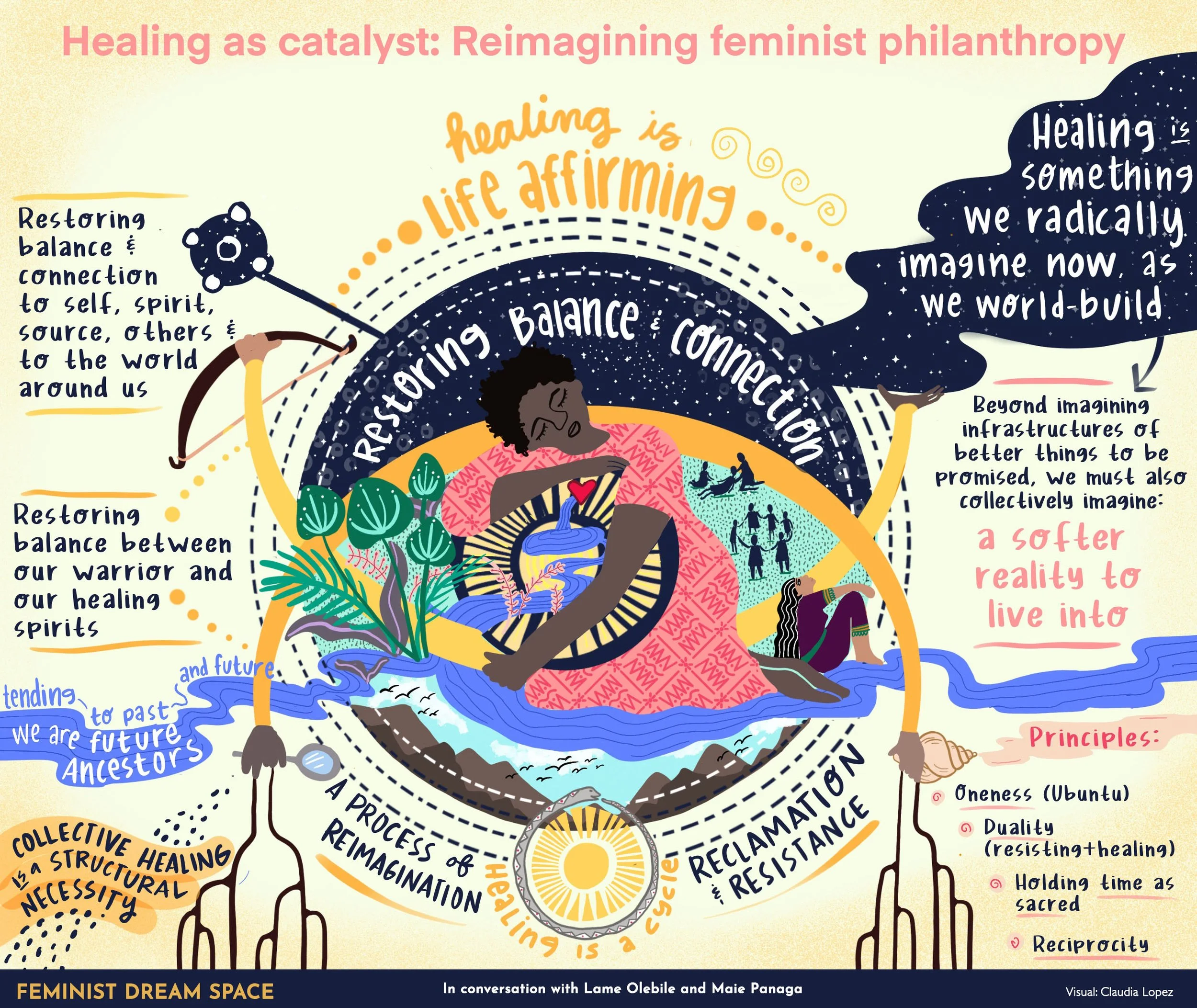
Healing is the restoration of balance and connection.
It is a living, breathing process of reclamation, re-imagination, and resistance, one that is both intensely personal and radically collective. It's a process of restoring our connection to the self, spirit, the Earth, God and deities (however you conceive of them) and one another.
Healing is a cycle, that is life affirming and is grounded in the principles of:
Oneness (Ubuntu) - Being in right relationship with oneself and with all living beings
Duality and balance - Between our warrior spirit and our healing spirit. A space where we fight for a life-affirming future and intentionally hold and care for those on the front lines and for each other so pain, harm and trauma don't reproduce.
Reciprocity -Where what we take must be returned and what we give out shall be returned to us.
Sacred time - Holding time - past, present and future - as sacred, characterized by eras and shifts. Time has been suffocated with tasks and actions. Understanding how change can happen at different times.
Imagining healing and how it is experienced and turning it into reality is a necessity. Acknowledging that we don't know how much can truly be healed, but we need to think about it as something we start radically imagining and enacting now.
What becomes possible when healing is the starting point?
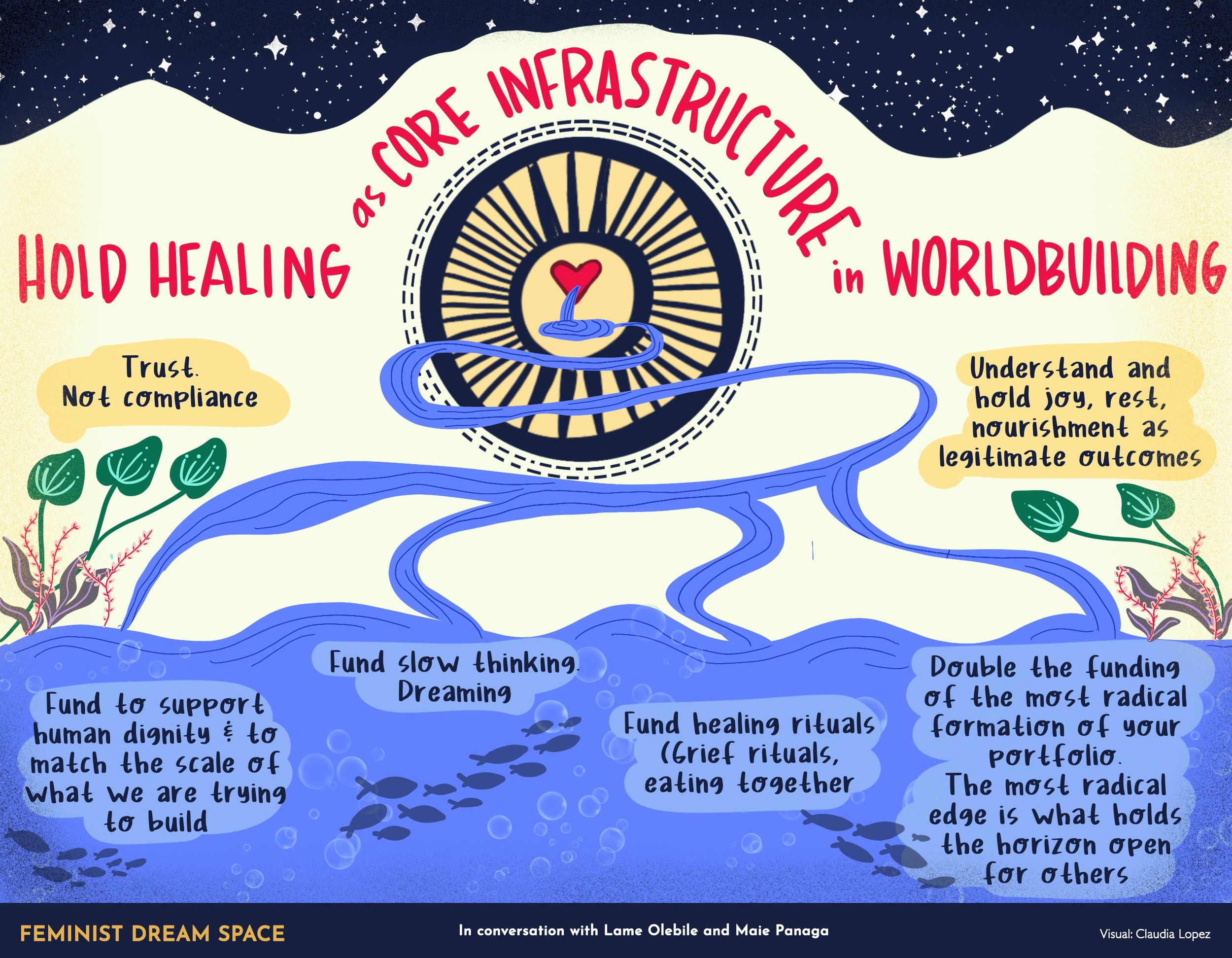
What would feminist philanthropy look like if it resourced movement infrastructure and was designed to cultivate and resource safety, trust, imagination?
Healing should be treated as essential and structural in supporting movement work.
Philanthropy needs to recognize the psychological, spiritual and financial impact of resistance and worldbuilding. Activists often have no infrastructural safety nets, face violence and backlash and are forced to "perform their wound" for resources, while donor institutions finance projects, compliance, and rigid metrics.
When healing is held as essential and at the center, the full dignity of human life is resourced and supported. Living wages, health insurance, security, care and space for imagining are resourced.
Across history and around the world, examples of healing and community care systems exist.
We can learn valuable lessons from them. Some examples include:
The Sudan Resistance Committee. Formed emergency response rooms to deliver food, water, and medical care in areas where international aid is unreachable. They built the tea, a neighborhood kitchen that has fed entire communities through revolution and war up to the present time.
Feminist Republik. Brought together African women human rights defenders to address feminist approaches to crisis, funding for healing, reclaiming narratives, collective care, and challenging systems through storytelling, music, dance, and traditional practices.
The Greenbelt movement. Founded in 1977 by Nobel Laureate Wangari Maathai in Kenya, is a grass roots organization that empowers women to conserve the environment and improve their livelihoods. It encourages women to create tree nurseries, providing them with a small income for saplings that survive, enhancing self-reliance.
Zapatistas. An indigenous political movement in southern México that built the "caracoles", structures for dignified life outside of the state system. Caracoles included community health services, agroecological education, collective land stewardship for collective wellness.
La Via Campesina. An international network that advocates for a community care approach deeply intertwined with food sovereignty, peasant feminism and agroecology.
Brazil's Landless Workers' Movement. Approaches care and healing through a holistic model that integrates physical health, mental well-being, ecological restoration, and social solidarity within their settlements and encampments.
The Lotus Center in Egypt. A healing and wellbeing practice that is grounded in the lotus flower, a prominent symbol of creation and rebirth, often depicted in ancient temples and tombs.
The Underground Railroad. A network of safe houses, nourishment, and rest that supported the Black liberation movement in the USA during the 19th century.
The Combahee River Collective. A pioneering Black feminist lesbian socialist organization active in Boston (USA) from 1974-1980, that names and acknowledges that their liberation cannot be separated from their survival, bodies, and rest.
Kindred Southern Healing Justice Collective. Created by Black Women in the US South, has held space since 2006, for a radical truth: collective healing and collective liberation are inseparable. They develop healing justice practices rooted in cultural and political traditions that honor ancestral wisdom while responding to the conditions communities face today.
The Movement for Black Lives. Emphasizes holistic care, blending spiritual practices, mental health resources, and community-based support, such as mutual aid, to promote restorative wellbeing.
ACT UP (AIDS Coalition to Unleash Power), formed in 1987, redefined care and healing for people living with HIV/AIDS by merging militant, direct-action activism with grassroots health advocacy.
Resources:
Reclaiming ritual, community, and imagination in times of crisis - Article by Lame Olebile and Maie Panaga
The 3rd Feminist Republik Festival by UAF Africa - by Alliance Magazine

“Healing is a living, breathing process of reclamation, reimagination, and resistance—one that is both intensely personal and radically collective.”
“When healing is held as essential and at the center, the full dignity of human life is resourced and supported. Living wages, health insurance, and security are resourced.”
“A body that can’t heal, can’t organize. Healing is a condition that make organizing possible.”