
Reimagining and Recreating Feminist Humanitarian Futures
With Fanta Toure, Sara Abbas and Soheir Asaad

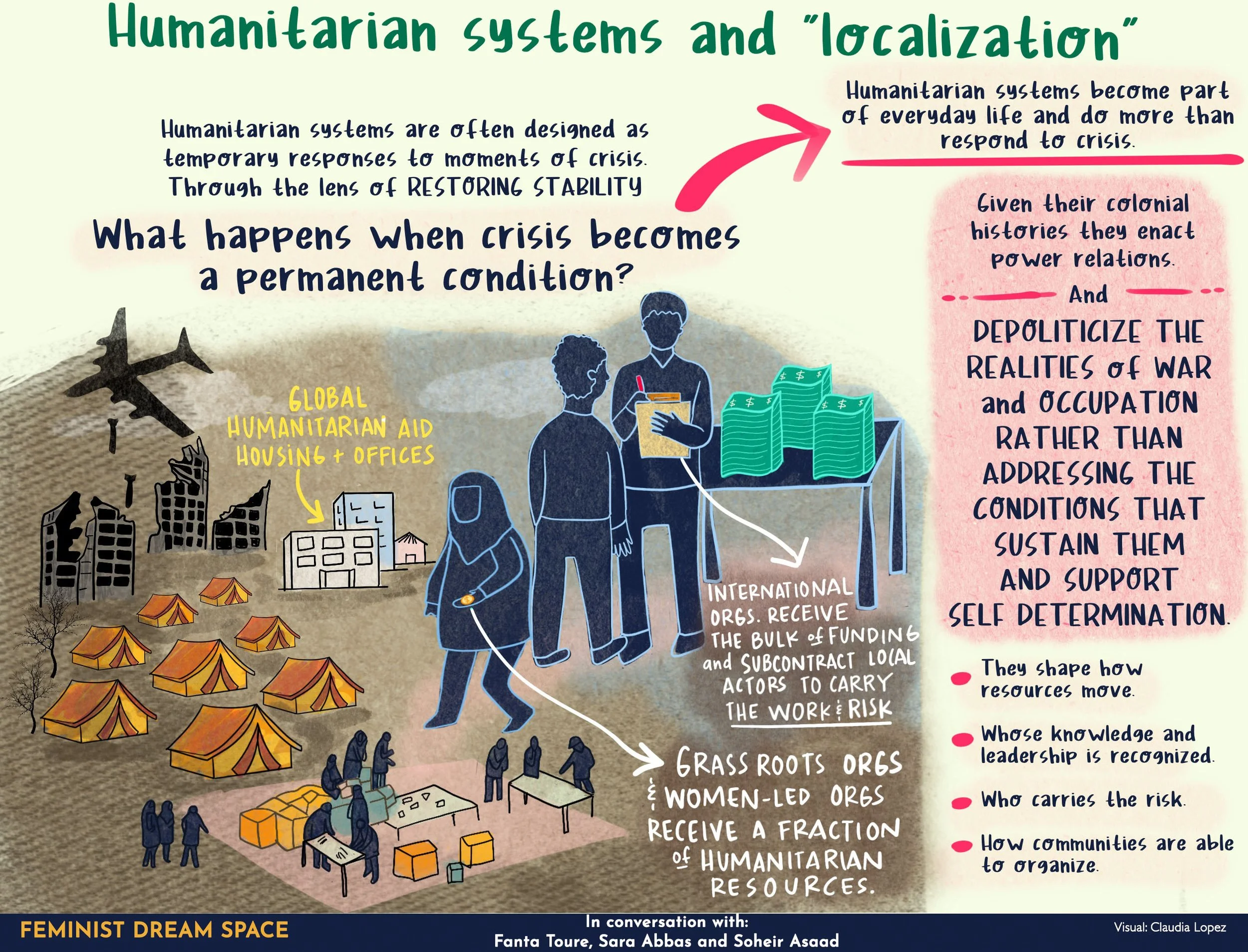
Humanitarian systems are often designed as temporary responses to moments of crisis. But what happens when ‘crisis’ becomes a permanent condition? In places experiencing war, occupation and protracted instability, humanitarian systems become part of everyday life and do more than respond to immediate needs. They shape how resources move, whose knowledge and leadership are recognized, who carries risk, and how communities are able to organize.
In this powerful conversation, we were joined by Fanta Toure, CEO of Resilio Fund; Sara Abbas, a Sudanese journalist and researcher; and Soheir Asaad, a Palestinian organizer and the Advocacy team member at Rawa, a Palestinian grassroots resourcing initiative.
Together, we explored the colonial power relations embedded within humanitarian systems and how these interventions can sometimes reproduce these power relations and sustain the conditions it seeks to address. We explored what it would mean to move beyond reforming humanitarian systems to reimagining the very frameworks through which crises are understood.
We also looked at what communities are already doing. Across Sudan, Palestine and elsewhere, people are creating systems of mutual aid and care that protect dignity and sustain life, often with very few resources. Rather than arising merely in reaction to acute crises, these actions draw strength from long-standing traditions of political resistance and community care.
What can these practices teach us about the humanitarian futures we want to build?
What does it mean to look beyond localization?
For decades, movements and local humanitarian actors have pushed for the localization of aid: shifting greater resources, decision-making and power towards people and organizations rooted in the communities experiencing crisis. But there remains a wide gap between the rhetoric and the reality of localization.
Grassroots organizations, women-led organizations, groups and collectives continue to receive a fraction of humanitarian resources, while international organizations often receive the funding and then subcontract local actors to carry out the work. Those local actors also stay when crises become most dangerous. They hold the relationships, knowledge and trust needed to respond, while carrying enormous levels of risk. What is being localized is often risk, rather than resources and power. The conversation invited us to turn the question around: What does it mean not to localize?
The challenge is not simply to make localization more meaningful, but to question the humanitarian framework itself. As Soheir emphasized, shifting resources and decision-making to local actors is not enough if communities are still expected to operate within externally defined humanitarian priorities. What would it mean to recognize and resource people's organizing as part of their broader political struggles for liberation?
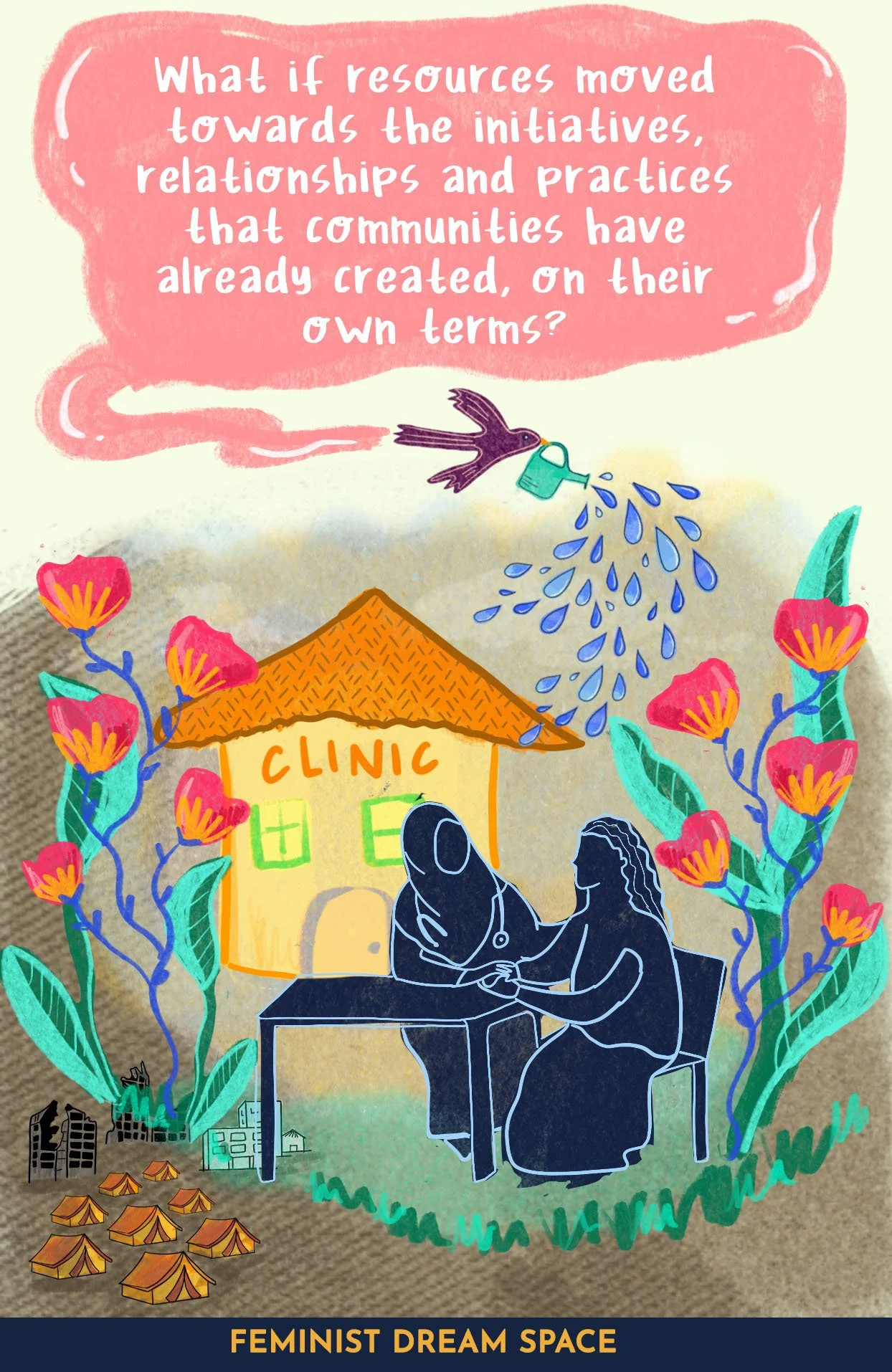
Rather than bringing large humanitarian systems into communities and finding local people to deliver their work, what if resources moved towards the initiatives, relationships and practices that communities have already created, on their own terms?
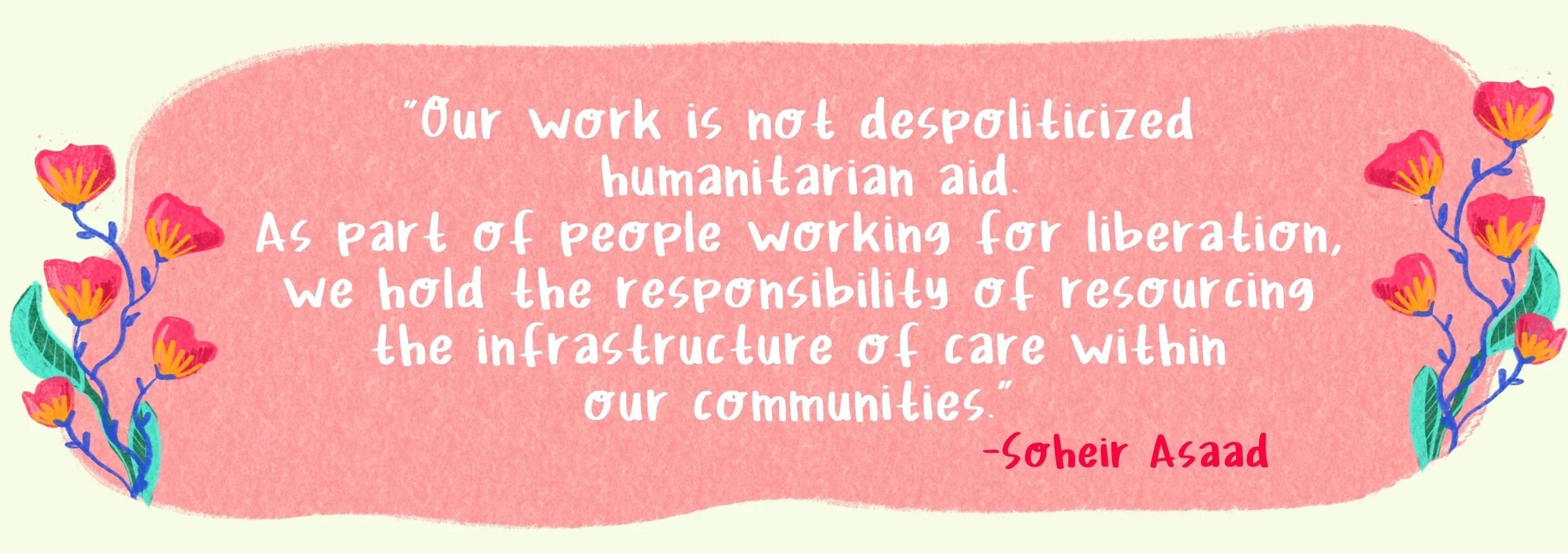
Humanitarian systems often seek to restore stability while disconnecting crises from the political struggles that preceded them. In Palestine as Soheir shared, this can mean depoliticizing the realities of war and occupation, rather than addressing the conditions that sustain them or supporting Palestinian self-determination. Similarly, Sudan’s devastating war, which began in April 2023, followed the December Revolution, a sustained uprising led by women and youth under the banner of “freedom, peace and justice." As Sara reflected, the war can be understood as a counter-revolutionary force, blocking the possibilities for radical change and preserving extractive and exclusionary power relations.
The infrastructure of care already exists
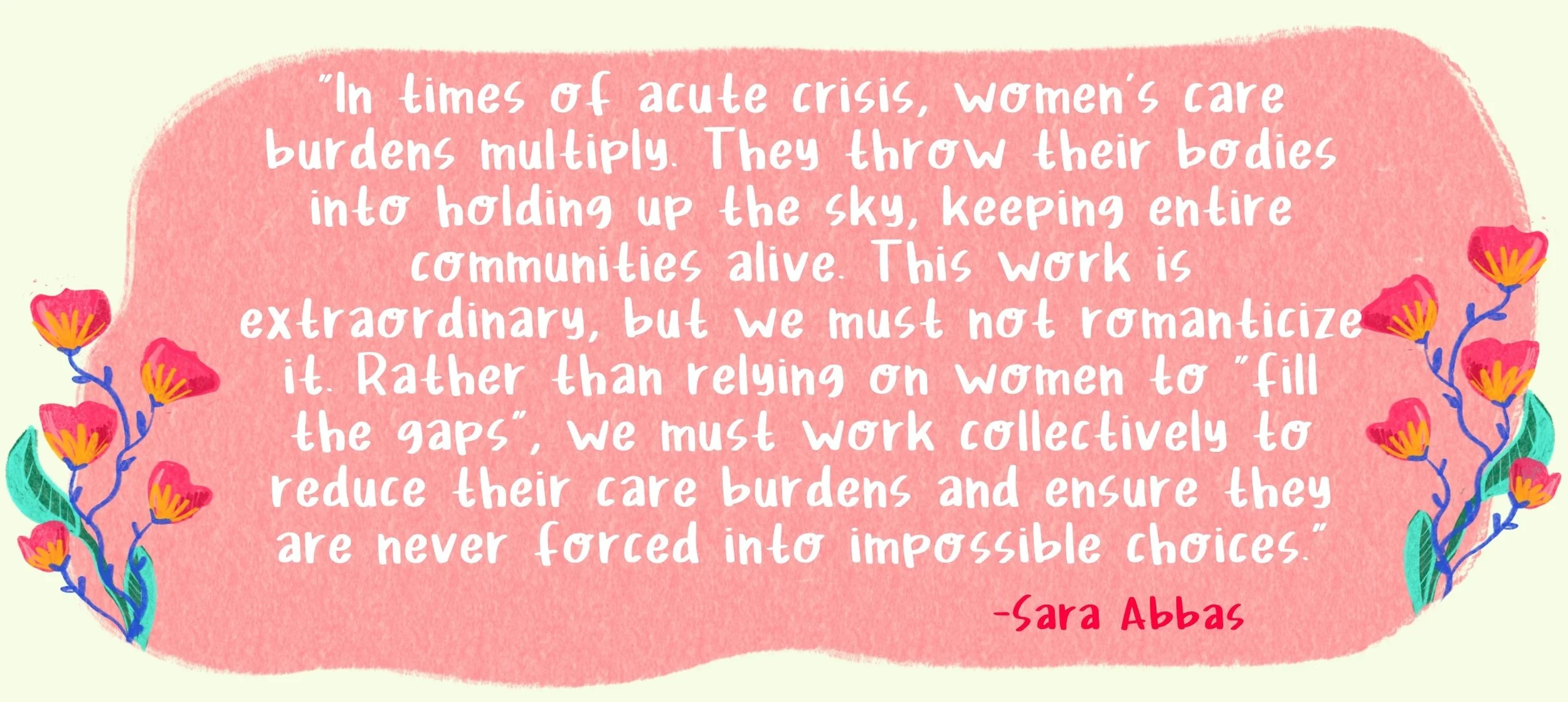
Throughout the conversation, we kept returning to the idea that people are already taking care of each other. Communities hold deep knowledge about what they need and how to respond. They organize food, shelter and healthcare, look after their neighbors, create mutual aid networks and find ways to protect dignity under extraordinarily difficult conditions. These practices can become invisible when we focus only on formal humanitarian systems and financial resources. Women's care labour, in particular, is often overlooked despite being central to how communities survive and sustain themselves.
Sara shared the example of the Emergency Response Rooms (ERRs) in Sudan, which grew out of the organizing infrastructure of the resistance committees. When war broke out, people transformed schools into shelters, reopened abandoned clinics, organized medical professionals and responded to the immediate needs of their communities. Women organizing within the ERRs by starting “women’s emergency rooms” also brought greater attention to women's needs and to sexual violence.
These experiences remind us that humanitarian action does not begin when an institution arrives. Communities already have histories, relationships, political struggles and practices of care from which they respond. These practices are often integral to how communities exercise agency, sustain collective resistance and build the power to shape their own futures. Understanding them requires recognizing the political struggles and specific histories from which they emerge, rather than separating practices of care from their broader contexts.
There are many forms, but they don’t need to become a template
How do we support these practices without flattening, professionalizing or institutionalizing them? Mutual aid and community care take many forms because histories, political contexts, cultures and resources differ. The goal is not to identify one successful model and reproduce it everywhere.
This asks philanthropy and humanitarian actors to begin somewhere different: not with the grant, the framework or the intervention, but with supporting what people are already doing. What knowledge already exists? What relationships are sustaining people? What does the community say it needs? And how can resources strengthen that work without taking control of it?
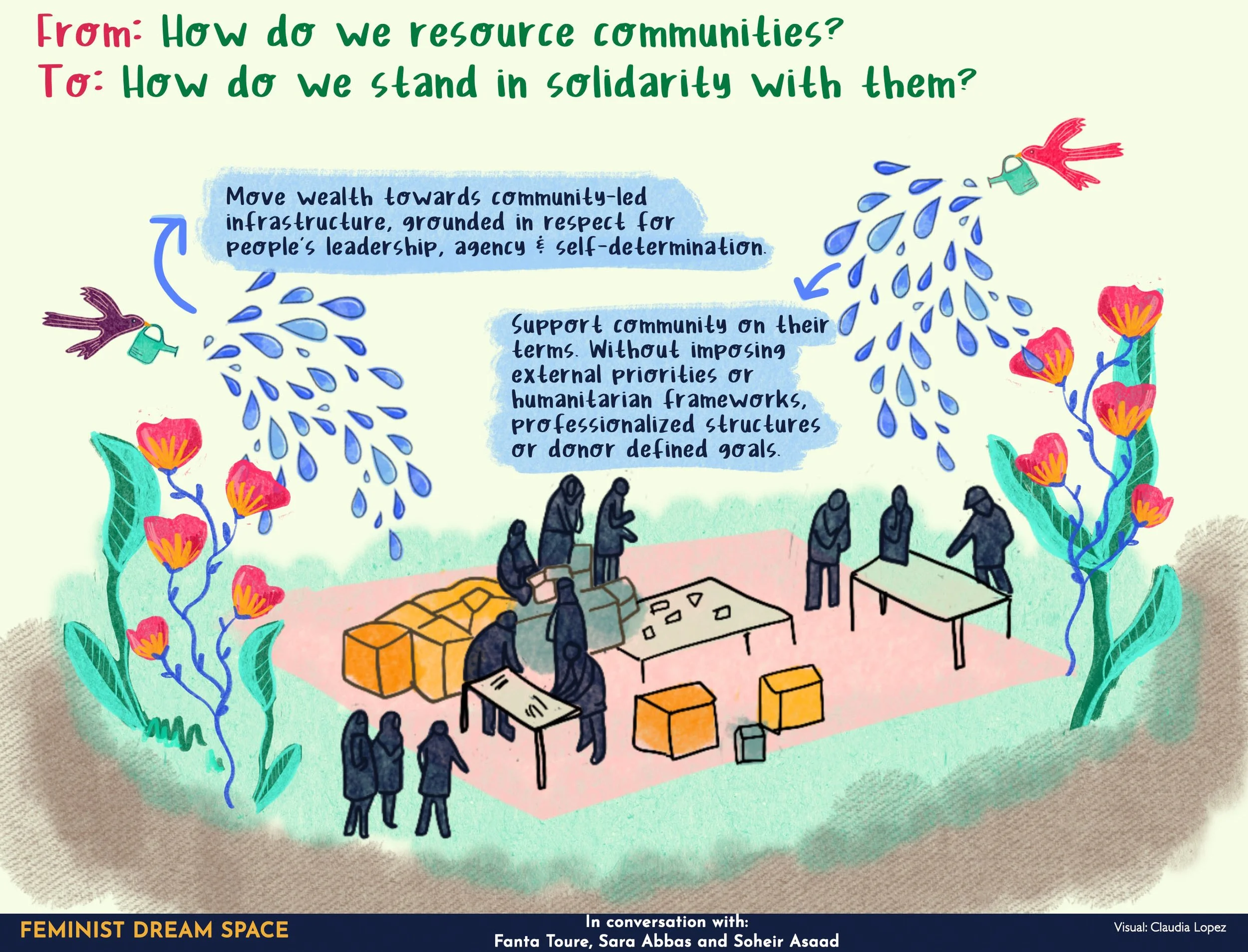
The question then shifts from how do we resource communities? towards- how do we stand in solidarity with them? It means moving wealth towards community-led infrastructure, grounded in respect for people's leadership, agency and self-determination. It means supporting communities on their own terms, without imposing external priorities or requiring their work to fit humanitarian frameworks, professionalized structures or donor-defined outcomes.
What does it mean to be in service to the community?
Reimagining humanitarian futures also requires reimagining leadership and organizations themselves. Fanta, Sara and Soheir spoke about collectivity and humility as feminist leadership practices: challenging individualism and competition, recognizing class and positionality, and remaining accountable to the communities whose struggles we are part of.
Soheir shared how Rawa has questioned organizational practices inherited from philanthropy, including rigid five- and ten-year strategic plans that can become disconnected from the realities of perpetual crisis. Instead, the organization asks what structures allow it to remain accountable and responsive to communities in Palestine.
As Soheir reminds us, “Plans are not sacred. What’s sacred is to respond to people’s needs” This invites a shift from thinking of communities as recipients of support towards asking what it means for organizations and funders to be in service of community.
Care gives us the ‘long breath’
This work is difficult, so we ended by asking: where do we find joy, beauty and the ability to keep going? Sara spoke about finding beauty in the people she works with, Nabta accompanies the Self Help Group Organization (SHGAN), a women's organization in Blue Nile, Sudan, that builds self-help groups and cooperatives for women and girls. She finds joy in togetherness and collectivity, and in everyday practices like drinking coffee, singing, drumming, telling stories and laughing together. These practices are not separate from political work. They create and sustain communities.
Soheir spoke about how centering human relationships gives her the “long breath” she needs to continue. This is not about romanticizing resilience or expecting communities to endure crises endlessly. It is about recognizing care as a collective organizing principle, held through our relationships, families, communities and collective struggles.
Perhaps this is also where we can begin to see different humanitarian futures already taking shape: in the ways people are caring for one another, protecting dignity and creating community in the midst of crisis.
Resources:
Nabta for Feminist Resourcing, Key messages for feminist funders in Sudan
On Rawa, being in solidarity, and supporting collective and liberatory practices in Palestine:
https://www.thenewhumanitarian.org/opinion/2025/09/29/aid-is-political-philanthropy-must-take-stand

“If people designed the humanitarian system, it wouldn’t need to exist.”
“Plans are not sacred. What is sacred is to respond to people’s needs.”
“We are trying to wrap the warmth of people helping each other in a cloth of steel so we can pass it through a system that would make sense to some.”