
Busting the myths of AI and reimagining technology as a tool for feminist liberation
With Anasuya Sengupta from Whose Knowledge and Timnit Gebru from Dair Institute

This illuminating conversation lifted the veil on "AI," revealing the mythos surrounding it. Anasuya and Timnit spoke with clarity and honesty about the problematic histories, aspirations, and visions of these technologies and their creators. They opened a window to better understand what we must resist, and how we can thoughtfully engage with existing tools and platforms. They reminded us that there are no binary choices or easy answers, yet we can still exercise our agency and power. These technologies can be utilized, reimagined, and developed to center and benefit our communities and their liberatory efforts, as demonstrated by the inspiring examples they shared.
So, what is AI?
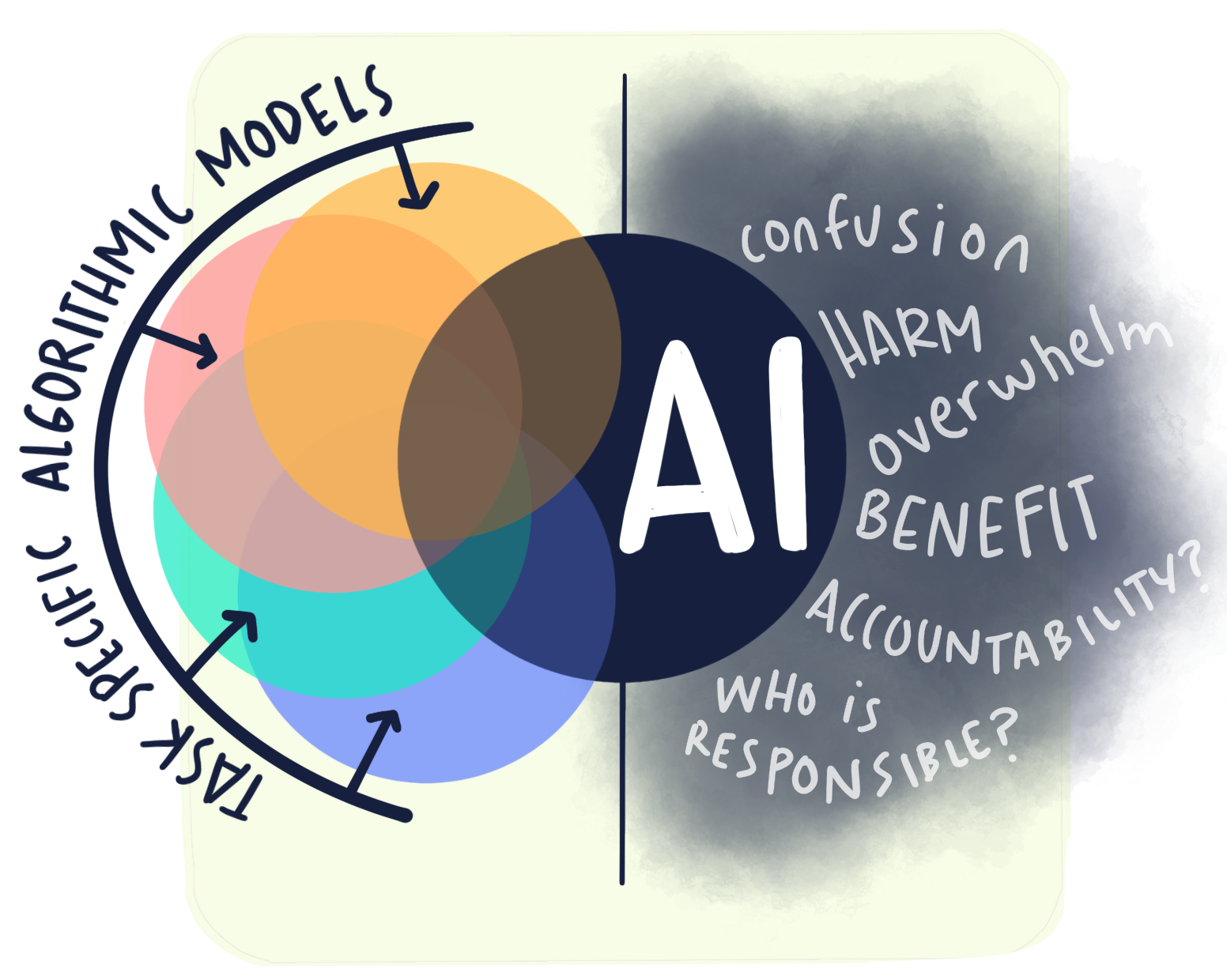
AI, Artificial Intelligence, is essentially a marketing term coined by a homogeneous group of white men in the 1950s. However it is important to understand that this is not one single overarching technology but rather different algorithmic techniques that can be used for specific purposes. For example: automated machine translations, automated speech transcriptions, face recognition systems, image generators, video generators, etc. These are all different systems that fulfill specific tasks.
Timnit emphasizes the importance to understand and call things with more specificity as the nebulous and overarching term “AI” leads not only to confusion and overwhelm, it complicates discussions around its benefits and harms and has led to the evasion of privacy and challenges with accountability.
Some of us don't like the term "AI", for good reason. This term is inaccurate and misleading, as Anasuya reminded us that “these systems are neither artificial nor intelligent. Instead, they operate through pattern recognition of vast datasets, relying heavily on human involvement for their creation, maintenance, and refinement. Unlike human intelligence, they lack the capacity for true originality or creativity, not to mention wisdom.
AI: the machine god
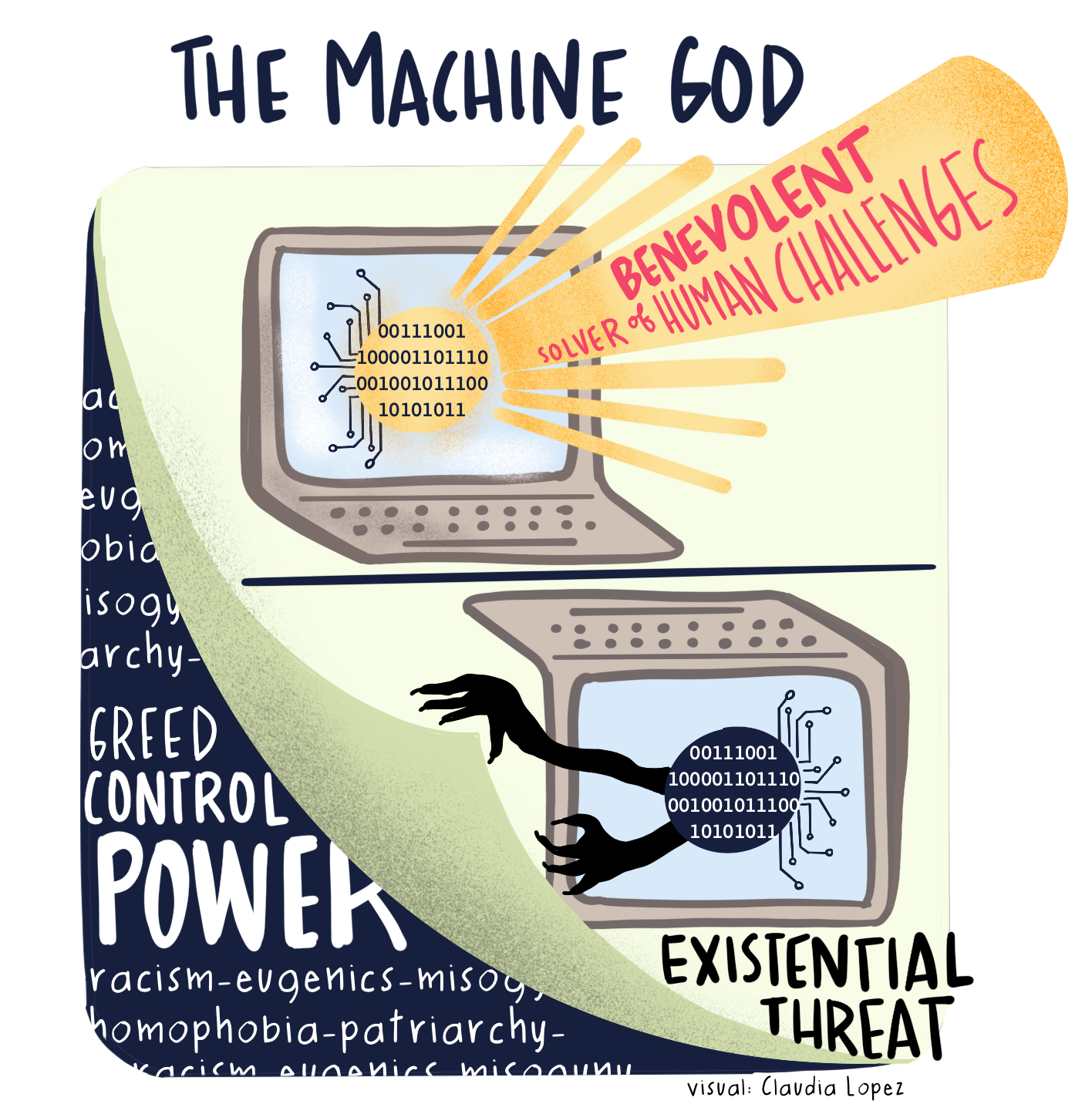
There is a prevailing narrative among many in the technology field that AI is or will be capable of solving humanity's greatest challenges, from disease to climate change, to presenting a benevolent facade of a “digital god”. However, the flipside of this narrative is that this “digital god” can also pose existential threats if controlled or developed by the "wrong hands."
This astute portrayal reveals a continuation of old power dynamics manifesting in new technologies, driven by profit motives and an insatiable desire for control. It positions a group of predominantly white men, often holding patriarchal, homophobic, racist, and eugenic ideologies, as the rightful developers and controllers of these technologies. These same people argue for less regulation and bureaucracy, and push for the construction of massive data centers that exploit workers and degrade the environment, often in the Global South, and among marginalized communities in the north,with little accountability.
While we should remain vigilant, we should not feel discouraged. Anasuya reminds us that as feminists we are about contesting power and we should feel solidly grounded in the critique of power, even if the mythos is to make tech opaque and to make it hard for us to fully understand how various technologies work. We know that ultimately it’s all about power and control,and know how to push back on that.
What actions can we take? What does Feminist liberatory tech look like?
The future is not inevitable. We have agency and choice to shape it. While technology often creates challenges, it can also be used as part of the solution, for example using automations to flag graphic content and hate speech, or to support language accessibility and sovereignty. As Timnit emphasized, it’s important for us to support the visions and efforts of people who share our values and have the right intentions, while we also continue to be vigilant and push back against harmful practices and technologies. We have agency and can make choices everyday about which technologies to use and how.
We should also remember that creativity is a human endeavor and bust the hype that AI is creative. In a time where technology is so overreaching we should intentionally uplift human agency and human creativity, supporting artists directly and the folks that are fighting back in creative ways.
When it comes to developing new technologies, Anasuya invites us to ask ourselves: Who is this for? What are we trying to achieve? What kind of world do we want to build together? By answering these questions, we can reverse engineer our approach. Unlike big tech, we need to shift paradigms and prioritize technologies that serve marginalized communities, recognizing that these solutions can ultimately benefit the wider population and we can create a tapestry of smaller technologies that are task and context-specific with well curated data tailored to the unique needs of communities.

Around the world we can find examples of people building new and independent technologies to support the needs and visions of their communities.
We can learn valuable lessons from them. Some examples include:
Te Hiku Media - Māori Speech AI Model Helps Preserve and Promote New Zealand Indigenous Language
The Algorithmic Justice League (AJL) - AJL's mission is to raise awareness about the impacts of AI, equip advocates with empirical research, build the voice and choice of the most impacted communities, and galvanize researchers, policy makers, and industry practitioners to mitigate AI harms and biases. They are building a movement to shift the AI ecosystem towards equitable and accountable AI.
Dair Institute - Dair works on eliminating AI harms and accelerating imagination and creation of new technologies and tools addressing the needs of their communities. Their interdisciplinary works range from building state-of-the-art language technologies for some of the world’s most ignored languages to documenting the exploited workers fueling AI systems.
Data Workers Inquiry Project - Is a global, radically participatory research initiative spanning nine countries across five continents. It has developed a framework designed to turn hidden and precarious labor into a shared, politicized site for knowledge-making, public engagement, and tangible change.
Blacksky Algorithms - Is building the intercommunal net where communities can use decentralized tools to govern themselves, pool resources, and stay safe on their own terms.
Wiki For Refugees 2024 in Uganda - Is an initiative aimed at harnessing the power of Wikimedia projects to support and empower refugees and host communities in Uganda. By providing access to information and enabling their active participation in knowledge creation, we aspire to make a positive impact on the lives of displaced individuals.

Resources:
Don't miss our Catalytic Conversation with Jac from Numun: AI and Feminist Tech
In this provocative conversation with Jac we explore how technology intersects with power, surveillance, and social movements. How feminists can focus on using technology to address real community issues—such as tracking human rights violations or identifying invisible patterns of corruption—rather than simply reacting to existing tech and discuss what is needed to develop alternative systems. Plus so much more!
WhoseKnowledge - A Global-Majority led organization, working on knowledge and tech justice by recentering the majority of the world on the internet.
Numun Fund - A dedicated fund for feminist tech in and for the larger world.
Bridging the digital divide by building accessible multilingual tech(article) - byubhashish Panigrahi, Maari Zwick-Maitreyi, Claudia P. via WhoseKnowledge blog
The AI Con by Emily M Bender and Alex Hanna review – debunking myths of the AI revolution(article) - by The Guardian. Will new technology help to make the world a better place, or is AI just another tech bubble that will benefit the few?
Molly vs. THE MACHINES(film) - From a teenager’s suburban bedroom to the boardrooms of Silicon Valley, Molly Vs the Machines is the story of a heartbroken father’s quest to uncover the truth behind his daughter's death and his fightback against how the most powerful corporations of the modern age operate.
Remote Labor Index: Measuring AI Automation of Remote Work(paper)
AI agents get office tasks wrong around 70% of the time, and a lot of them aren't AI at all (article)- by The Register
Empire of AI (book) - Book by Karen Hao
Naomi Klein & Karen Hao: The Empire of AI and the Fight for our Future (video)
Unmasking AI (book) -by Joy Buolamwini. The technology of the future is bringing us back to the inequality of the past, but we can still prevent AI from amplifying discrimination.
Poet of Code - Dr. Joy Buolamwini advises world leaders, policymakers, and executives on redressing algorithmic harms. Founder or algorithmic justice.
Artists Land a Win in Class Action Lawsuit Against A.I. Companies (article) - published by Artnet
AI Art and its Impact on Artists (article)- Published by Association for Computer machinery ACM
What is AI slop? (article)- A technologist explains this new and largely unwelcomed form of online content. Published by The Conversation
Reclaiming human agency (video animation) - from the Presencing Institute series: Reclaiming human agency, navigating AI, social fracture and polarization. Animation by Jayce Pei Yu Lee

“Tech monopolies are associated with convenience — we are struggling against a world in which the collective consciousness around the threats has been co-opted towards favoring models where massive conglomerates hold extreme power. We should acknowledge that we are all complicit in colonial capitalism. There are no binary choice, yet every choice reflects agency and power and we can make choices of the sequencing and the combinations of tools we use based on the security and needs of our work, [our commitments and our communities.]”
“Feminist liberatory tech at the heart holds the analysis of power and scale as a tapestry [of different models, vs. an all encompassing model] And asks the questions: Who is this for? What are we using it for? What is the world we want to see and build? And reverse engineer from there.”